Watch a seven-story cartoon dog or a grinning cold-brew cup lift off a field at dawn, and it’s easy to forget you’re looking at a flying machine. But special shape balloon engineering is exactly that: a discipline that takes the same physics keeping a classic teardrop-shaped hot air balloon aloft and bends it, quite literally, into a character with ears, arms, and a personality. It’s one of the most demanding corners of ballooning, and it’s a big part of why our shop still gets a thrill every time a new shape stands up for the first time.
At Wicked Balloons, we build and fly both custom shapes and advertising balloon projects for clients who want their brand to do something a billboard never could: float. Getting there takes a lot more than a clever design sketch.
Why a Character Balloon Isn’t Just a Bigger Balloon
A standard hot air balloon envelope is a fairly forgiving shape. Its smooth curves distribute the stress of hot air pushing outward evenly across the fabric, so the load on any single panel or seam is manageable. A special shape balloon throws that efficiency out the window on purpose. Arms, antennae, snouts, and other appendages are aerodynamically inefficient and structurally awkward, yet they’re exactly what makes the balloon recognizable from the ground.
That tension between “looks right” and “flies right” is the heart of special shape balloon engineering. Every feature that makes a character instantly identifiable also introduces a structural problem that has to be solved before the balloon ever leaves the ground.
The Skeleton Nobody Sees: Load Tapes and Internal Structure
Underneath the painted fabric of any special shape balloon is a hidden skeleton of load tapes: reinforced webbing sewn into the seams that carries the actual weight of the basket, burners, and passengers up through the envelope. On a standard balloon, these tapes run in clean vertical lines from the equator to the crown. On a character balloon, they have to be routed around ears, snake through narrow limbs, and sometimes double back entirely to keep a protruding shape from collapsing or twisting under load.
Designers typically address the challenge with a few core techniques:
- Internal baffles that connect an appendage back to the main envelope, sharing the load rather than letting the feature hang unsupported
- Extra load tape density around any point where fabric geometry changes sharply, since that’s where stress concentrates
- Careful gore shaping, where each individual fabric panel is cut on a computer-modeled curve rather than a simple straight taper
- Selective venting so hot air still reaches every extremity, including narrow limbs that would otherwise stay cool and go limp
Get any of this wrong and the result isn’t just a bad-looking flight. An unsupported feature can flap, deform, or in a worst case add drag and instability the pilot has to fly around all day.
Airflow: Making Sure Every Limb Gets Warm
Hot air rises and pools at the top of an envelope, which is exactly where you want it in a classic balloon shape. In a character balloon, though, hot air has to travel sideways and even slightly downward to reach an outstretched arm or a floppy ear. If it doesn’t, that section of fabric stays cool, loses buoyancy, and sags, throwing off both the look of the balloon and its handling in the air.
This is why special shape balloon engineering leans so heavily on computational modeling before a single yard of fabric is cut. Engineers simulate how heated air will circulate through the proposed geometry, then adjust internal baffling and vent placement until every part of the character stays inflated and warm through a full flight.
Materials and Weight: The Never-Ending Trade-off
Every extra inch of surface area on a special shape adds weight, and weight is the enemy of a balloon that still needs to fit through standard shipping containers, launch reliably, and respond predictably to a pilot’s burner inputs. Fabric selection becomes a balancing act between:
- Strength high enough to handle the stress concentrations around complex seams
- Weight low enough that the finished envelope doesn’t require an oversized burner system to fly efficiently
- Color-fastness and coating durability, since character balloons spend far more time being photographed up close than they do flying at altitude
Ripstop nylon remains the standard envelope material across the industry for good reason: it’s light, it’s strong along both axes of the weave, and a small tear stays small instead of spreading. On a special shape, that ripstop quality matters even more, because a tear near a stressed seam on an appendage has fewer neighboring panels to share the load if it starts to run.
From Sketch to Sky: The Build Process
A character balloon usually starts as a two-dimensional illustration, but getting from a flat drawing to a three-dimensional flying shape is where the real engineering happens. The design is broken into hundreds of individual fabric panels, each one plotted, cut, and sewn by hand, then test-inflated cold before the envelope ever sees a burner flame. Cold inflation lets the build team check proportions, seam alignment, and structural behavior without the added variable of heat, and it’s usually the first moment a design fully “reads” as the character it was meant to be.
Only after cold inflation checks out does a shape move on to hot air testing, weight and balance verification, and eventually certification. It’s a slower, more iterative process than building a standard balloon, and it’s a big part of why special shapes carry a premium over off-the-shelf envelopes.
Why It Matters for Brands and Fans Alike
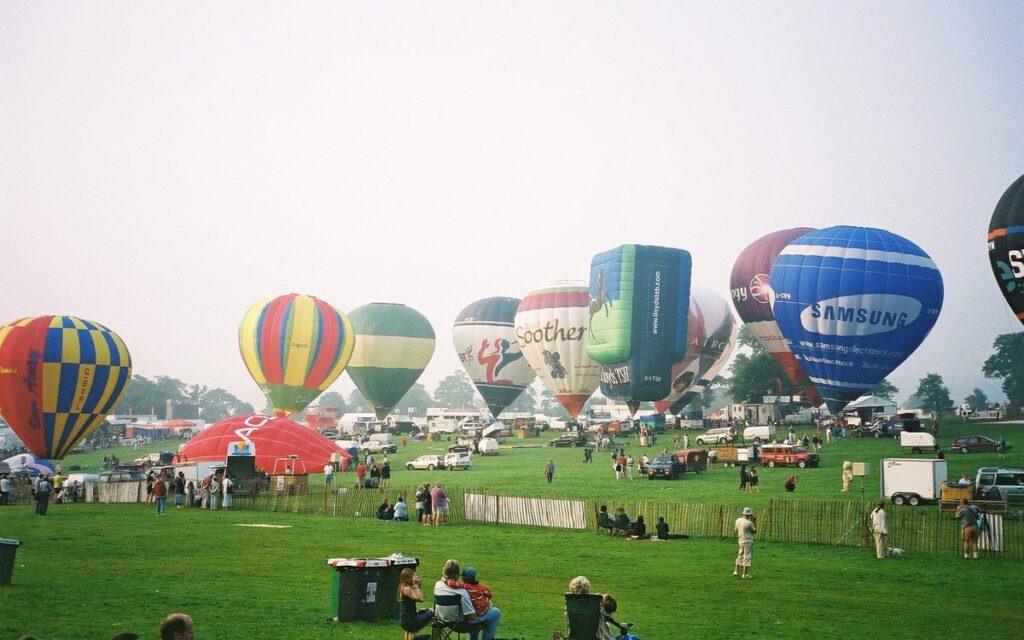
For companies commissioning an advertising balloon, the engineering behind the scenes is invisible, and that’s the point. What audiences see is a mascot or logo floating gracefully overhead; what makes that possible is a design team that solved dozens of structural puzzles long before launch day. The same craftsmanship shows up in the special shapes you’ll see gathered at balloon festivals across the country, where a field full of pumpkins, cows, and cartoon characters is really a showcase of applied fabric engineering as much as it is a spectacle.
If you’ve never watched a special shape balloon inflate up close, it’s worth the early wake-up call. If you’d rather experience the more classic side of ballooning first, our sunrise balloon rides are a gentler introduction to the same basic principles that make every one of these giants fly.
Frequently Asked Questions
How long does it take to build a special shape balloon?
Custom special shapes typically take several months from initial design through fabrication and certification, depending on the complexity of the character and how many unique panel shapes the design requires.
Are special shape balloons harder to fly than standard balloons?
Yes, generally. Uneven surface geometry and appendages can affect how a balloon responds to wind and burner input, so pilots typically need specific experience or training on a given shape before flying it solo.
Why do some character balloons only fly in calm conditions?
Protruding features like ears, arms, or antennae catch wind more than a smooth envelope surface does, so special shapes are often more sensitive to wind and are flown within a narrower weather window than standard balloons.
Can any logo or mascot be turned into a balloon?
Most two-dimensional logos and characters can be adapted, though very thin or spindly features sometimes need to be simplified or reinforced internally so the shape holds up structurally in flight.
Whether it’s a grinning mascot at a festival or a client’s logo drifting over a stadium parking lot, every special shape balloon in the sky represents months of quiet problem-solving before it ever caught its first breeze. That’s the part we love most about this work.