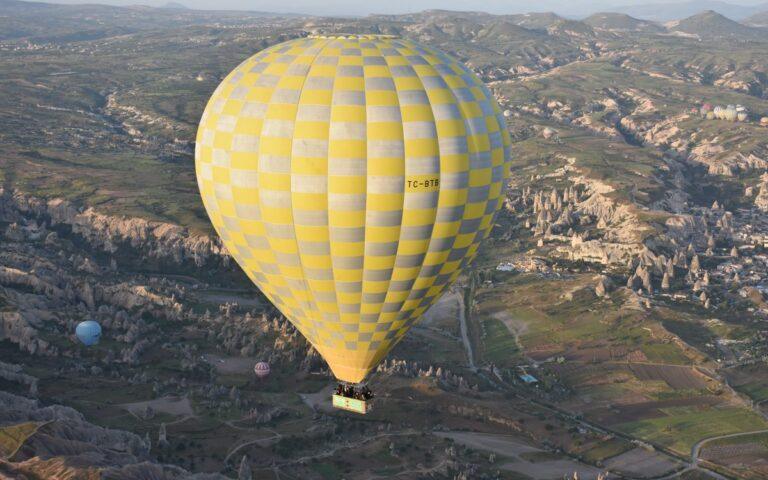
Every sunrise flight we launch here in Worcester lasts about an hour, drifting a few miles on the morning breeze. So it’s hard not to feel a little awe when you learn that the hot air balloon distance record stands at roughly 25,360 miles, set on a single continuous flight around the entire planet. No refueling, no landing, nineteen days aloft. It’s one of the great, quietly remarkable stories in the history of flight, and it belongs as much to the world of ballooning as any sunrise ride does.
The Hot Air Balloon Distance Record: A Flight That Circled the Globe
The current hot air balloon distance record belongs to the Breitling Orbiter 3, piloted by Bertrand Piccard and Brian Jones. On March 1, 1999, the two men lifted off from Chateau-d’Oex, Switzerland, and didn’t touch down again until March 21, landing in the Egyptian desert after 19 days, 21 hours, and 47 minutes in the air. Over that span they covered roughly 46,759 kilometers, or about 25,360 miles, becoming the first team ever to circle the Earth nonstop in a balloon.
It’s worth being precise about what kind of balloon made this possible. The Orbiter 3 was a Rozière balloon, a hybrid design combining a helium-filled cell with a hot air chamber beneath it. Solar heating during the day and controlled burner use kept the gas at the right pressure and altitude without burning through fuel at the rate a pure hot air balloon would. That hybrid engineering is precisely what allowed a flight of this length to exist in the first place; a conventional hot-air-only balloon simply cannot carry enough propane to stay airborne for three weeks.
Why the Record Took So Long to Fall
Long-distance ballooning attempts go back decades. Double Eagle II made the first successful transatlantic balloon crossing in 1978, and Double Eagle V crossed the Pacific in 1981. Richard Branson and Per Lindstrand pushed distance and speed records further through the 1980s and ’90s with their Virgin-sponsored flights. Piccard himself had already failed at two previous round-the-world attempts before the Orbiter 3 succeeded on its third try.
What made round-the-world flight so hard wasn’t stamina or courage. It was weather. A balloon has no engine to push it in a chosen direction; it goes wherever the wind at its chosen altitude happens to be blowing. Circling the globe means finding and riding the jet stream, a narrow, fast-moving river of air, for nearly three weeks without losing it, running out of ballast, or getting pushed off course over hostile territory. Several teams in the 1990s got tantalizingly close only to be forced down early.
The Longest-Duration Flight: Two Eagles
Distance and duration records don’t always belong to the same flight. In 2015, Troy Bradley and Leonid Tiukhtyaev flew the Two Eagles, another Rozière balloon, from Saga, Japan, across the Pacific to a landing off the coast of Baja California, Mexico. The flight lasted about 160 hours and 37 minutes, or roughly six days and sixteen hours, making it the longest-duration balloon flight ever recorded and covering more than 6,600 miles in the process. It stands as one of the great modern feats of long-distance ballooning, even though the Orbiter 3 still holds the overall distance crown.
A Few Other Milestones Worth Knowing
- Double Eagle II (1978): First successful crewed balloon crossing of the Atlantic Ocean, flown by Ben Abruzzo, Maxie Anderson, and Larry Newman.
- Double Eagle V (1981): First crewed balloon crossing of the Pacific Ocean.
- Fedor Konyukhov (2016): Completed a solo nonstop circumnavigation in a Rozière balloon in just under 11 days, the fastest solo round-the-world flight.
- Virgin Pacific Flyer (1991): Branson and Lindstrand set distance and speed records crossing the Pacific in a Rozière balloon.
What These Records Have in Common
Every flight on this list shares a few traits. Each used a Rozière or gas-assisted balloon rather than a pure hot air envelope, since only that hybrid design carries enough lift and endurance for multi-day flight. Each depended on a skilled meteorology team on the ground plotting jet stream routes hour by hour. And each crew accepted real risk: extreme cold at altitude, unpressurized or minimally pressurized capsules, and the simple fact that once you commit to the jet stream, there’s no quick way down.
None of that diminishes what happens on a much smaller scale every morning over New England. The physics that let the Orbiter 3 ride the jet stream around the planet are the same physics that lift our balloons off a dewy field at sunrise: heated air is lighter than cool air, and a well-flown balloon goes exactly where the atmosphere intends to take it. Scale is the only real difference.
Frequently Asked Questions
What is the current hot air balloon distance record?
The Breitling Orbiter 3, flown by Bertrand Piccard and Brian Jones in March 1999, holds the record at approximately 25,360 miles (about 46,759 kilometers) on a nonstop flight around the world lasting nearly 20 days.
Was the Breitling Orbiter 3 a true hot air balloon?
It was a Rozière balloon, a hybrid that pairs a sealed helium cell with a hot air chamber below it. This combination is what allowed the flight to last weeks rather than hours, since a pure hot-air-only balloon can’t carry enough fuel for that kind of endurance.
How long can a typical hot air balloon stay in the air?
A standard recreational or sightseeing hot air balloon, like the ones we fly over Worcester and the surrounding hills, usually stays aloft for about an hour, limited by propane supply and the practical goal of a smooth, scenic ride rather than a distance record.
Who currently holds the record for the longest-duration balloon flight?
Troy Bradley and Leonid Tiukhtyaev hold the duration record, staying aloft for about 160 hours and 37 minutes aboard the Two Eagles during their 2015 Pacific crossing from Japan to Mexico.
Records like these are a reminder of just how much history and ingenuity live inside something as simple as a balloon and a burner. We may not be chasing the jet stream around the globe, but every flight we fly carries a little of that same spirit. If you’d like to learn more about our crew and how we got into this business, visit our about page, or if today’s the day you’d rather just go see the sunrise from a basket, you can book a reservation and find out what all the fuss is about.