Stand in a New England field before sunrise and watch a balloon come to life, and you’ll probably ask yourself the same question every first-time passenger does: why do hot air balloons float in the first place? The answer isn’t magic, and it isn’t a mystery reserved for physicists. It comes down to one simple, elegant principle that’s been understood for over two centuries, and once you see it, you’ll never look at a balloon launch the same way again.
The Simple Science of Why Hot Air Balloons Float
At its core, the reason hot air balloons float is buoyancy, the same force that lets a cork bob on a pond or a life vest keep you above water. Buoyancy happens whenever something less dense is surrounded by something more dense. A balloon envelope filled with heated air is, quite literally, lighter for its size than the cooler air around it, so the cooler air pushes it upward.
Air is a fluid, just like water, even though we rarely think of it that way. It has weight, it has density, and it behaves according to the same rules that let a wooden boat float on the ocean. Heat a gas and its molecules spread farther apart. Spread them far enough, and a given volume of that gas weighs less than the same volume of cooler air. That weight difference is the entire secret behind why hot air balloons float.
Density Is the Whole Story
It helps to picture air molecules as a crowd of people in a room. When they’re packed shoulder to shoulder, that section of the room is dense and heavy for its size. Heat the room up, and people spread out, leaving more open space between them. The same number of molecules now occupies more volume, and that volume weighs less overall. A hot air balloon envelope is essentially a giant pocket of that “spread out,” lighter air, held inside a fabric shell.
What Actually Makes the Air Inside Rise
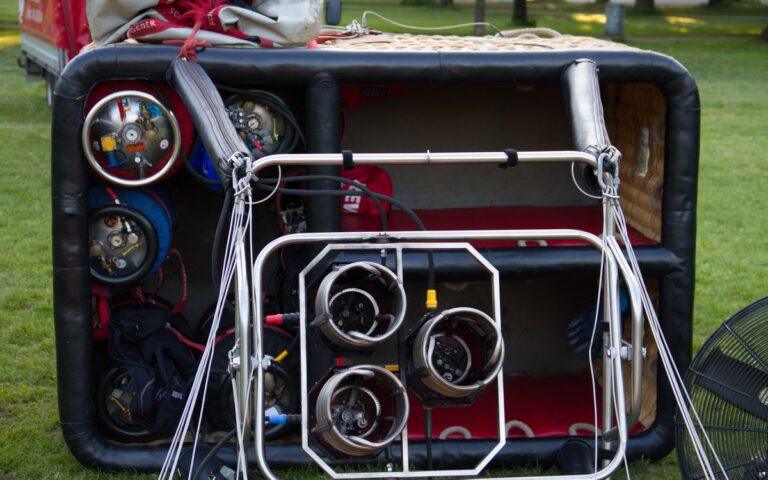
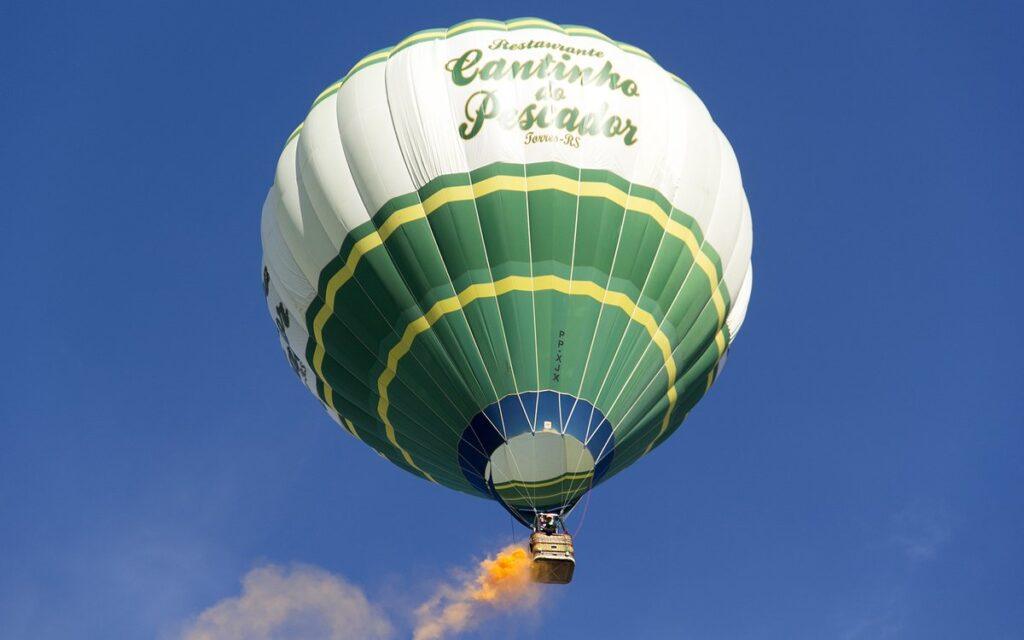
Here’s where the burner comes in. A propane burner mounted above the basket blasts a column of flame up into the mouth of the envelope, heating the air trapped inside. As that air warms, it expands and becomes less dense than the ambient air outside the envelope. Once the air inside is light enough compared to the air outside, the whole system, envelope, basket, burner, fuel tanks, and passengers, becomes buoyant and lifts off the ground.
This is also why balloon pilots keep firing the burner intermittently throughout a flight instead of just once at launch. Hot air naturally loses heat over time as it mixes with cooler air and radiates warmth through the envelope fabric. To maintain altitude, the pilot has to periodically add more heat, essentially topping off the buoyancy. Let the air inside cool too much, and the balloon gently descends, which is exactly how pilots control altitude with such precision.
- Heat added: air inside expands, becomes less dense, balloon rises
- Heat maintained: balloon holds a steady altitude
- Heat allowed to fade: air inside cools, density increases, balloon descends
Why Hot Air Balloons Float but Never Fly Like an Airplane
It’s worth pausing on a common point of confusion. Hot air balloons don’t have engines pushing them forward, and they don’t have wings generating lift the way an airplane does. They float rather than fly in the traditional sense, entirely at the mercy of buoyancy for vertical movement and entirely at the mercy of the wind for horizontal movement. A pilot can take the balloon up or down by managing heat, and by finding different wind directions at different altitudes, a skilled pilot can even nudge the flight path somewhat. But there’s no steering wheel, no rudder, no way to fight the wind directly.
That combination, precise vertical control paired with total surrender to the breeze, is part of what makes ballooning feel so different from any other kind of flight. It’s quiet, unhurried, and remarkably smooth, since you’re moving with the air rather than through it.
A Two-Hundred-Year-Old Idea That Still Works
The Montgolfier brothers demonstrated the first successful hot air balloon flights in France in 1783, and the underlying physics they stumbled onto hasn’t changed one bit since. Modern balloons use nylon or polyester envelopes, computer-monitored propane burners, and far more sophisticated materials than paper and silk, but the fundamental reason they lift off the ground is identical to the one that carried those early aeronauts over Paris. Heat the air, lower its density, let buoyancy do the rest.
That staying power is part of the appeal. There’s something grounding, ironically enough, about experiencing a flight technology built on a principle so basic that you can demonstrate it with a paper lantern and a candle.
Experiencing Buoyancy for Yourself
Reading about density and buoyancy is one thing. Feeling your basket lift silently off the grass at sunrise, with nothing but heated air holding you aloft, is another experience entirely. If you’re curious to see the science in action, a sunrise hot air balloon ride over the New England countryside is about as memorable a physics lesson as you’ll ever get, minus the classroom.
Frequently Asked Questions
Why do hot air balloons float instead of sinking?
They float because the heated air inside the envelope is less dense than the cooler air surrounding it. Just as a less dense object floats on water, a balloon full of less dense air floats within the denser air of the atmosphere, rising until it reaches air of roughly matching density or the pilot cools the air inside to descend.
How hot does the air inside a hot air balloon get?
Pilots generally keep the air inside well below temperatures that would damage the envelope fabric, using bursts from the burner to maintain enough heat for buoyancy without overheating the material. The exact target varies with the outside air temperature, altitude, and the balloon’s total weight.
Can a hot air balloon steer itself?
Not directly. There’s no engine or rudder to push the balloon in a chosen direction. Pilots control altitude by managing heat, and since wind often blows in different directions at different heights, an experienced pilot can rise or descend to catch a favorable current. Horizontal movement, though, always belongs to the wind.
Why does the balloon need to be inflated with cold air first?
Before the burner ever fires, the crew inflates the envelope with unheated air using a large fan. This gives the fabric its full shape safely, on the ground, so that when the burner does ignite, it’s heating air already filling a properly formed envelope rather than trying to inflate limp fabric with an open flame.
Next time you watch a balloon rise into a pink morning sky, you’ll know there’s no trick to it, just heat, density, and a very old, very reliable law of nature quietly doing its job.