Watch a hot air balloon lift off at sunrise and it looks like magic: a limp pile of fabric on the ground becomes an enormous, silent sphere floating hundreds of feet in the air. But the answer to how do hot air balloons work turns out to be refreshingly simple, and it hasn’t changed much since the very first flights over two hundred years ago. No engines pushing it up, no propellers, no wings. Just heat, air, and a bit of basic physics that anyone can understand.
How Do Hot Air Balloons Work? The Basic Idea
Every hot air balloon is built around one principle: hot air is lighter than cold air. When you heat the air inside the balloon’s envelope (that’s the technical name for the big fabric bag), it expands and becomes less dense than the cooler air surrounding it outside. Less dense air rises through denser air, the same way a bubble rises through water. That’s really the whole trick.
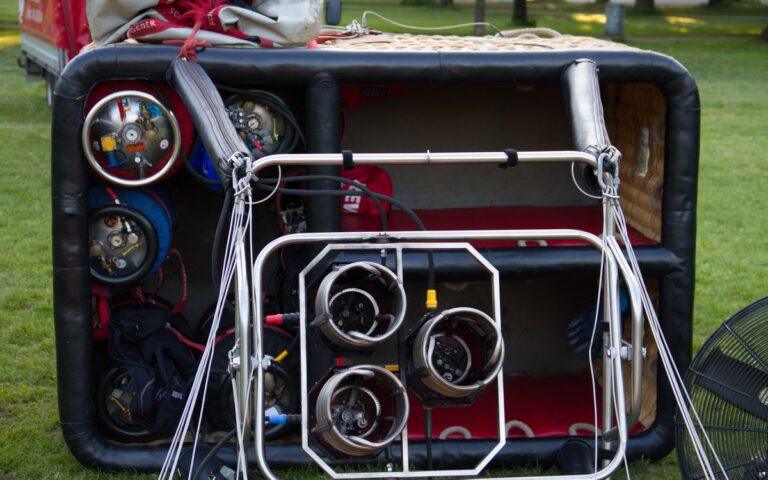
A propane burner mounted above the basket shoots a controlled flame up into the mouth of the envelope, heating the air trapped inside. As long as the air inside stays hot enough, the balloon stays buoyant and floats. Let it cool, and the balloon gently descends. There’s no steering wheel and no throttle in the traditional sense — just heat management.
The Physics Behind the Lift
The scientific concept at work is buoyancy, first described in principle by Archimedes more than two thousand years ago in relation to fluids and objects submerged in them. Air behaves like a fluid, too. A hot air balloon displaces a large volume of air, and if the air inside the envelope weighs less than the air it displaces, the whole system floats upward. It’s a satisfying answer once you see it: understanding how do hot air balloons work really just comes down to understanding how gases behave when you heat them.
Here’s what actually happens inside the envelope:
- The burner heats the air, causing the air molecules to spread out and move faster.
- Spread-out molecules mean fewer of them in a given space, which makes the heated air less dense.
- Less dense air weighs less per cubic foot than the surrounding cooler air.
- The lighter, heated air rises, carrying the envelope, basket, and passengers with it.
Pilots control altitude by adjusting how much they fire the burner. More heat means more lift and a climb; less heat, or none at all, lets the balloon cool slightly and sink. It’s a remarkably direct relationship between temperature and altitude.
Steering With the Wind, Not Against It
One question we hear constantly on our sunrise balloon rides is how pilots steer without a rudder or motor. The honest answer is that they don’t steer sideways — they steer up and down instead. Wind direction and speed typically change with altitude, so an experienced pilot reads wind layers and moves the balloon up or down into a layer heading the direction they want to travel.
This is part of why balloon flights over New England almost always happen near sunrise. That’s when winds are calmest and most predictable, giving pilots the smoothest layers to work with and passengers the gentlest possible ride.
A Quick Word on History
Hot air ballooning isn’t a modern invention. The Montgolfier brothers, Joseph-Michel and Jacques-Étienne, launched the first untethered flight carrying passengers in France in 1783, proving that heated air alone could lift a vessel into the sky. The basic physics they stumbled onto through experimentation is the same physics that lifts every balloon flying today, including the ones we fly out of Worcester, Massachusetts.
What has changed since then is the materials and equipment: modern envelopes are made of lightweight, heat-resistant nylon or polyester rather than paper and cloth, and propane burners replaced open fires. The underlying science, though, is exactly what those pioneering French brothers discovered.
Why the Shape and Size Matter
A balloon’s envelope isn’t just a big round shape for looks. Volume matters enormously, because more volume means more heated air, which means more lift. That’s why balloons built to carry more passengers, or special-shape balloons built for advertising and film work, need to be engineered carefully to keep enough volume and heat efficiency to fly safely and consistently.
This is also why weather conditions matter so much for scheduling a flight. Air density changes with temperature and altitude, so pilots and ground crews check conditions closely before every launch to make sure the day’s air will cooperate with the balloon’s physics.
Frequently Asked Questions
Do hot air balloons use any fuel besides the burner flame?
No. The propane burner is the only source of heat, and therefore the only source of lift control. There’s no separate engine or fuel system driving the balloon forward or upward.
How high do hot air balloons typically fly?
Altitude varies by flight and conditions, since pilots move up and down deliberately to find favorable wind layers. Passenger flights are generally kept at altitudes that balance a good view with calm, manageable winds.
Is it dangerous if the burner stops working?
Balloons are built with redundant burner systems for exactly this reason, and pilots are trained extensively in safe descent procedures. A balloon doesn’t simply drop when air cools; it descends gradually, the same gentle way it climbed.
Why do most balloon flights happen at sunrise?
Winds are calmest and most stable in the hours right after dawn, which gives pilots the most predictable air to read and the smoothest experience for passengers. It’s also simply a beautiful time to be airborne.
The physics behind flight is simple, but experiencing it firsthand is something else entirely. If reading about the science has you curious to feel it for yourself, we’d love to have you aboard for one of our sunrise flights over New England.