Long before anyone dreamed of sunrise flights over New England, the first hot air balloon flight lifted a rooster, a duck, and a sheep into the French sky – and changed how humanity understood the possibility of flight forever. What happened next, over the course of a few remarkable months in 1783, set in motion everything that balloonists like us still do today.
At Wicked Balloons, we spend our mornings doing what people once thought was impossible: rising gently off the ground under a envelope of hot air, drifting wherever the wind decides to take us. It never gets old, and it helps to remember where it all began.
The Montgolfier Brothers and the Spark of an Idea
The story starts in Annonay, France, with two brothers, Joseph-Michel and Jacques-Étienne Montgolfier, who ran a paper manufacturing business. Fascinated by the way smoke and heated air seemed to rise and fill a bag, the brothers began experimenting with small paper and fabric balloons over a fire.
Their early tests convinced them they were onto something real. On June 4, 1783, the Montgolfiers gave a public demonstration in Annonay, sending an unmanned balloon made of paper-lined silk into the air in front of a crowd of local dignitaries. It rose to a notable height and drifted for roughly a mile and a half before settling back to earth. Word of the spectacle spread quickly, reaching the French royal court in Paris.
A Sheep, a Duck, and a Rooster Take Flight
King Louis XVI and Queen Marie Antoinette wanted to see the Montgolfiers’ invention for themselves, and they wanted to know one thing above all: was it safe for a living creature to be carried aloft?
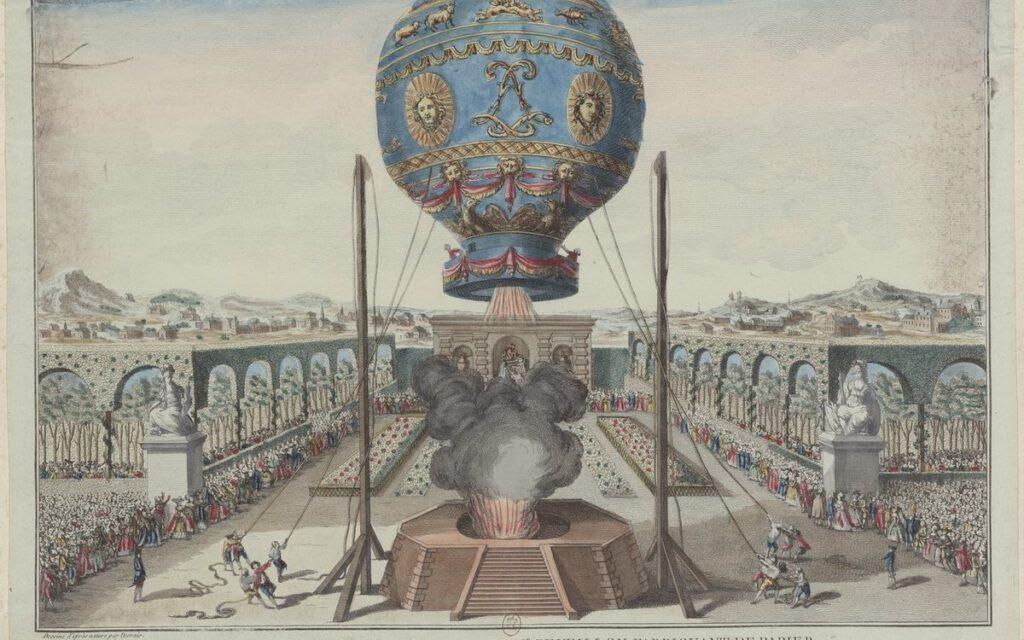
On September 19, 1783, at the Palace of Versailles, the brothers launched a balloon carrying three passengers – a sheep, a duck, and a rooster. The animals were chosen deliberately. The sheep was thought to have a physiology roughly comparable to a human’s, the duck was included as a control since ducks were already known to tolerate high altitude, and the rooster represented a bird that did not typically fly at great heights, to see whether the ascent itself might cause harm.
The balloon flew for about eight minutes and covered a couple of miles before landing safely, with all three animals unharmed. It was the confirmation everyone needed. If a sheep could survive the trip, a person could too.
The First Hot Air Balloon Flight With Humans Aboard
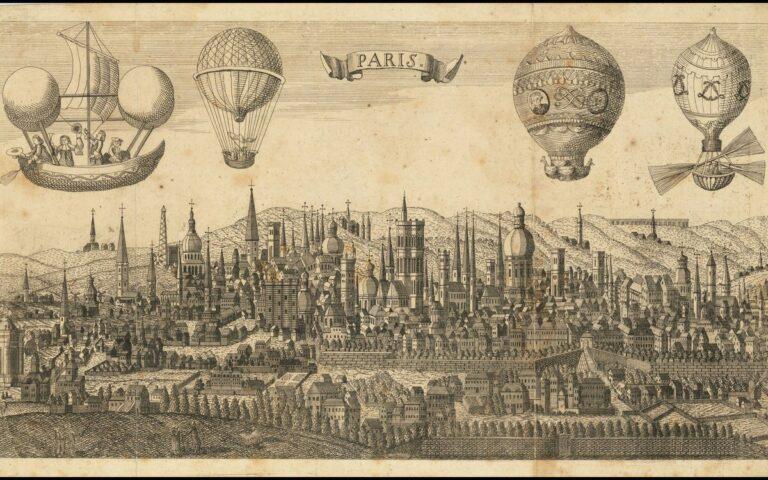
Two months later, on November 21, 1783, history changed for good. Jean-François Pilâtre de Rozier, a young science teacher, and François Laurent, the Marquis d’Arlandes, climbed into a basket suspended beneath a Montgolfier balloon in the Bois de Boulogne on the western edge of Paris.
This is widely recognized as the first hot air balloon flight carrying human beings, and it remains one of the great firsts in the history of exploration. The two men rose above the Parisian rooftops, tended a small fire to keep the air inside the envelope hot, and drifted across the city for roughly 25 minutes, covering a few miles before landing safely.
Pilâtre de Rozier had actually taken part in an earlier tethered ascent on October 15, 1783, becoming among the first humans to leave the ground in a balloon, though that flight stayed anchored to the earth by ropes. The November flight was different – fully untethered, fully free, and fully airborne over the city below. Paris, and soon the rest of the world, realized that humans could finally take to the sky.
Why the Montgolfier Design Worked
The brothers did not fully understand the science behind their invention. They initially believed they had discovered a special gas produced by burning straw and wool, rather than simply realizing that heated air is less dense than the cooler air around it and therefore rises. Even without a correct theory, their engineering instincts were sound.
A few basic principles carried through from that first hot air balloon flight to the balloons we fly today:
- Heating the air inside an envelope makes it lighter than the surrounding atmosphere, generating lift.
- A large enough envelope volume is needed to displace enough cooler air to lift the basket and its passengers.
- A heat source has to be maintained during flight, whether that is a straw fire in 1783 or a propane burner today.
- Balloons travel with the wind rather than against it, so steering is really a matter of choosing altitude to catch different air currents.
It is a genuinely elegant idea, and the fact that it still works exactly the same way, more than two centuries later, says something about how well the Montgolfiers understood their invention even without the physics vocabulary to explain it.
From Versailles to Worcester County
It is a fun thought experiment to imagine what Pilâtre de Rozier and the Marquis d’Arlandes would make of a modern flight. The wicker gondola would look familiar enough, and the basic physics has not changed a bit. But everything around it has been refined by two hundred and forty years of aviators, engineers, and dreamers who kept pushing the idea further.
We think about that lineage every time we get a balloon ready for a sunrise launch. Every flight we fly carries a little of that original spirit from the Bois de Boulogne. If you would like to learn more about how our crew approaches that tradition today, our about page has the full story of Wicked Balloons and the team behind every flight.
Frequently Asked Questions
When was the first hot air balloon flight?
The first untethered hot air balloon flight carrying humans took place on November 21, 1783, in Paris, France, with Jean-François Pilâtre de Rozier and the Marquis d’Arlandes aboard. An earlier unmanned test flight by the Montgolfier brothers had already taken place on June 4, 1783, in Annonay.
Who invented the hot air balloon?
Brothers Joseph-Michel and Jacques-Étienne Montgolfier, French papermakers from Annonay, are credited with inventing the hot air balloon after a series of experiments with heated air and fabric envelopes in the early 1780s.
Why did the Montgolfiers send animals up first?
Before risking a human passenger, the Montgolfier brothers and the French court wanted evidence that high-altitude travel would not harm a living creature. A sheep, duck, and rooster flew safely at Versailles on September 19, 1783, giving officials the confidence to approve a manned flight two months later.
How is a modern hot air balloon different from the 1783 version?
The core principle is unchanged – heated air rising inside an envelope – but modern balloons use propane burners instead of open fires, durable synthetic fabrics instead of paper-lined silk, and instruments for altitude and temperature that the Montgolfiers never had.
Two hundred and forty years after that first flight over Paris, the wonder of quietly rising off the ground has not faded one bit. If you have never experienced it for yourself, we would love to have you join us on one of our sunrise reservations and see why people have been falling for this simple, remarkable idea since 1783.