Every time a balloon lifts off the ground at sunrise, it is repeating an experiment first performed in the French countryside more than two centuries ago. So who invented the hot air balloon? Credit belongs to two brothers from Annonay, France: Joseph-Michel and Jacques-Étienne Montgolfier, papermakers by trade who turned a fascination with fire and smoke into the first practical flying machine.
Their story is one of curiosity, careful experimentation, and no small amount of nerve. It is also the reason we still call hot air balloons “Montgolfières” in France today, and it is a story we love telling our own passengers before they climb into the basket for a sunrise flight over New England.
Who Invented the Hot Air Balloon? Meet the Montgolfier Brothers
Joseph-Michel Montgolfier and his younger brother Jacques-Étienne ran a paper manufacturing business their family had built over generations. Joseph was the dreamer of the two, known for restless experiments and half-finished projects. Jacques-Étienne was the more practical partner, the one who tended to turn his brother’s ideas into something workable.
Sometime in 1782, Joseph noticed that a lightweight fabric bag held over a fire would fill with hot air and rise toward the ceiling. He suspected the smoke itself contained some special lifting gas, a theory that turned out to be wrong. What actually made the bag rise was simpler: heated air is less dense than the cooler air around it, so a balloon full of hot air floats the same way a cork floats on water. The brothers did not need the correct physics to get the results they wanted, and by early 1783 they were ready to test a much larger version in public.
The First Public Flight at Annonay
On June 4, 1783, the Montgolfiers launched a large fabric balloon in the marketplace at Annonay in front of a crowd of local officials. The unmanned balloon, built of paper and linen, rose an estimated one mile into the air and drifted for roughly a mile and a half before settling back to earth. Word of the demonstration spread quickly to Paris and reached the court of King Louis XVI.
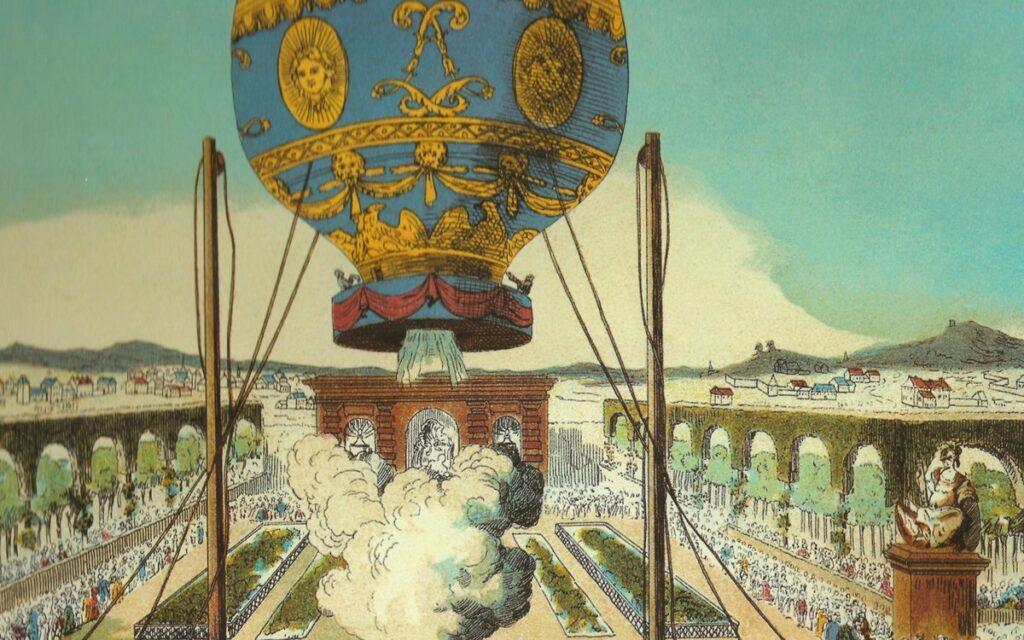
Encouraged by the reaction, the brothers built an even more elaborate balloon and were invited to demonstrate it at the royal palace in Versailles. That September, a Montgolfier balloon carried the first living passengers into the sky: a sheep, a duck, and a rooster, sent aloft as a kind of test flight to see whether animals could survive the trip. They landed safely a few miles away, and the Montgolfiers had their answer. It was time to try it with people.
The First Human Flight
The honor of being the first humans to leave the ground in a hot air balloon went to Jean-François Pilâtre de Rozier and François Laurent, the Marquis d’Arlandes. In October 1783, Pilâtre de Rozier made a series of tethered ascents, rising into the air while the balloon remained attached to the ground by ropes.
Then, on November 21, 1783, Pilâtre de Rozier and the Marquis d’Arlandes climbed into a basket suspended beneath a Montgolfier balloon in the Bois de Boulogne on the outskirts of Paris and cut loose entirely. They drifted freely over the city for around 25 minutes, covering several miles before landing safely. It was the first free, manned flight in history, and it changed how people understood what was possible.
A short list of the milestones that got them there:
- 1782: Joseph-Michel Montgolfier observes hot air lifting a small fabric bag
- June 4, 1783: First public unmanned balloon flight at Annonay
- September 1783: Sheep, duck, and rooster fly at Versailles before King Louis XVI
- October 1783: Pilâtre de Rozier makes tethered test ascents
- November 21, 1783: First free, untethered flight carrying two human passengers over Paris
Why the Montgolfier Design Still Matters Today
The basic principle the Montgolfier brothers proved has never really changed. Modern hot air balloons use a propane burner instead of a bonfire and a nylon envelope instead of paper and linen, but the physics is identical: heat the air inside the envelope, let it expand and rise, and the balloon lifts. Every sunrise flight we fly today is a direct descendant of what happened over that field in Annonay.
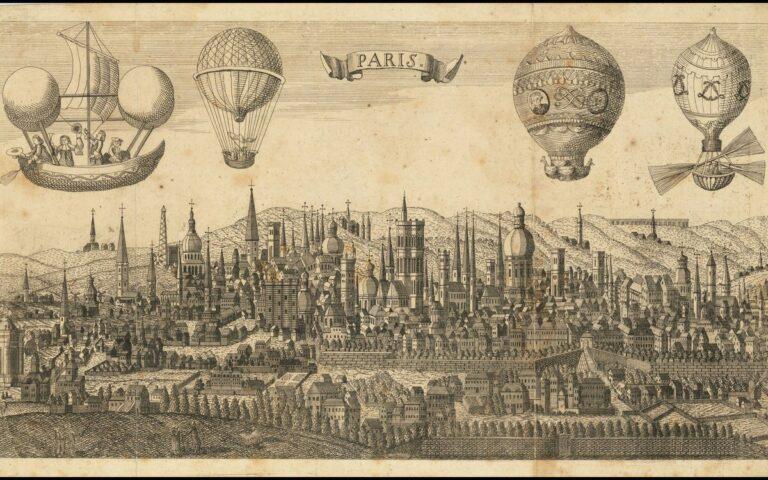
What is remarkable is how quickly ballooning became a full-blown sensation across Europe after that first flight. Within a couple of years, balloon flights were launching all over France and beyond, and the image of a balloon drifting over a landscape became one of the defining symbols of the era. It is a legacy we feel a real connection to at Wicked Balloons, where flying safely and thoughtfully is something we take seriously on every trip. If you would like to know more about how we approach that responsibility, our team’s story and our approach to flying is a good place to start.
From the Montgolfiers to Modern New England Skies
It took real courage to climb into that basket in 1783 without any precedent for what would happen next. Today’s passengers get all the wonder of flight with none of the uncertainty, thanks to more than two centuries of refinement in materials, burners, and pilot training. The rush of a sunrise launch is still very much intact, though. There is something timeless about watching the world fall away beneath you in complete silence, exactly the sensation those first Montgolfier passengers must have felt over Paris.
If that story has you itching to experience it yourself, we would love to take you up. You can browse available dates and book a sunrise balloon ride whenever you are ready.
Frequently Asked Questions
Who invented the hot air balloon?
The hot air balloon was invented by brothers Joseph-Michel and Jacques-Étienne Montgolfier, French papermakers who conducted the first public demonstration of an unmanned hot air balloon in Annonay, France, on June 4, 1783.
When was the first manned hot air balloon flight?
The first free, untethered flight carrying human passengers took place on November 21, 1783, when Jean-François Pilâtre de Rozier and the Marquis d’Arlandes flew over Paris in a Montgolfier balloon.
Why were a sheep, a duck, and a rooster the first balloon passengers?
Before risking human lives, the Montgolfier brothers wanted to know whether living creatures could survive a flight at altitude. In September 1783, they sent a sheep, a duck, and a rooster aloft at Versailles in front of King Louis XVI, and all three animals landed unharmed.
Did the Montgolfier brothers know why hot air made a balloon rise?
Not exactly. Joseph-Michel Montgolfier believed the smoke from the fire contained a special gas responsible for lift. In fact, it was simply the heated air itself, which is less dense than the surrounding cooler air and therefore rises, carrying the balloon with it.
More than 240 years later, the sight of a balloon rising into the morning sky still carries a bit of that same magic the crowds in Annonay must have felt. It is a history worth knowing, and an experience worth having for yourself.