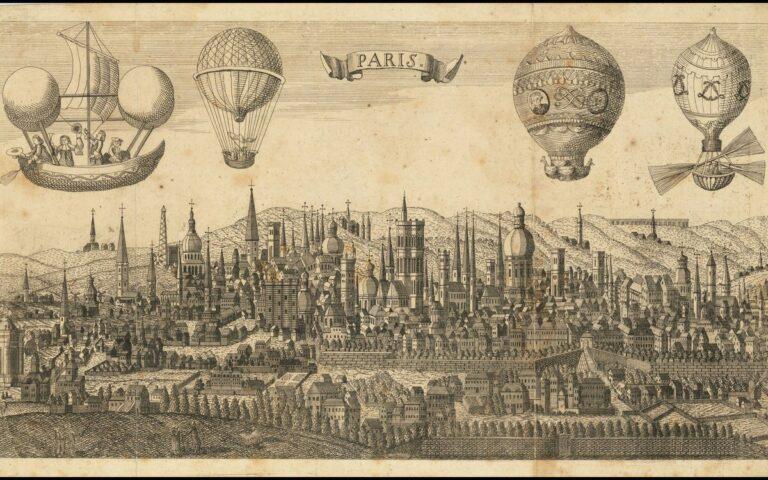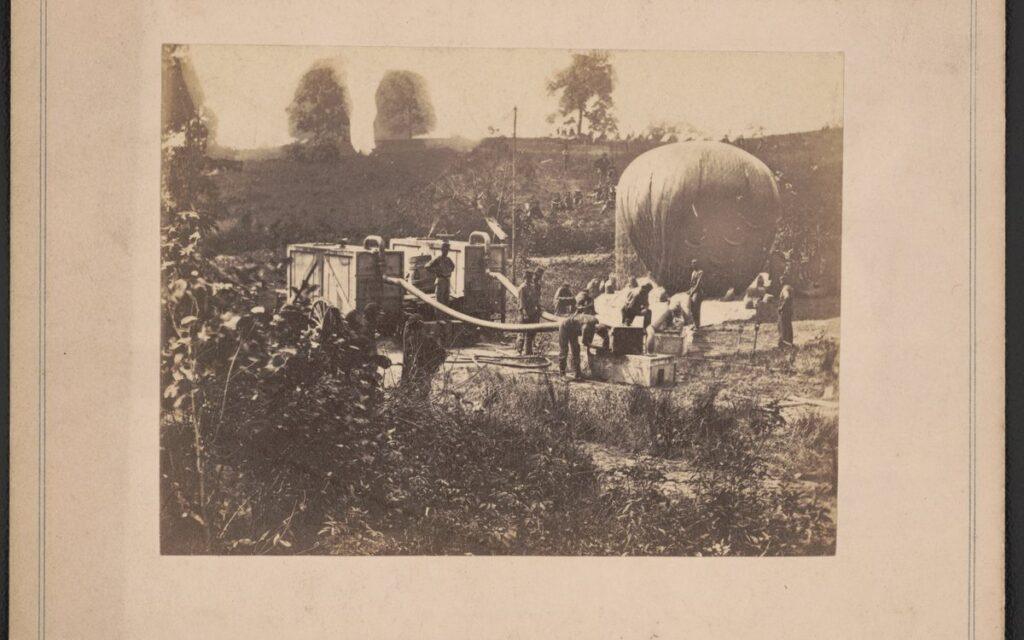
Long before drones scanned battlefields from above, Civil War hot air balloons were doing the same job with silk, netting, and a basket full of nerve. For a few remarkable years in the 1860s, gas-filled balloons floated over the armies of North and South, carrying observers who sketched enemy lines, counted campfires, and even sent messages back to headquarters by telegraph wire. It was one of the strangest and most inventive chapters in the history of flight, and it happened right in the middle of America’s bloodiest conflict.
The Balloonist Who Talked His Way Into the War
The central figure in this story is Thaddeus Lowe, a self-taught scientist and showman who had spent the years before the war building enormous balloons for long-distance flight experiments. In June 1861, just weeks after the war began, Lowe staged a demonstration in Washington, D.C. that changed everything. He ascended in his balloon Enterprise, tethered above the National Mall, and sent a telegraph message down the tether wire to President Lincoln describing the view of the capital spread out below him.
Lincoln was impressed enough to back the idea, and Lowe soon found himself appointed chief aeronaut of what became the Union Army Balloon Corps. He was not the only civilian balloonist angling for a role. Aeronauts John Wise and John La Mountain also offered their services, and for a while the competition among these balloon pioneers was almost as fierce as anything happening on the battlefield.
How Civil War Hot Air Balloons Actually Worked
These were not hot air balloons in the modern sense of a propane burner and a wicker basket built for pleasure flights. Civil War hot air balloons and their gas-filled cousins were typically inflated with hydrogen, produced on the spot using portable gas generators that Lowe designed himself. That was no small feat of logistics: filling a balloon meant hauling generators, acid, and iron filings by wagon over rough roads, often within range of enemy artillery.
Union balloons were generally flown tethered rather than free, rising a few hundred to a thousand feet above camp on a long rope. From that vantage point, an observer with field glasses could:
- Map the position and approximate strength of enemy troops and artillery
- Spot movements that signaled an advance or a retreat before they were visible from the ground
- Direct artillery fire by telegraph, correcting range in real time
- Sketch terrain for commanders who had only rough maps to work from
The telegraph link was the real innovation. A wire ran from a key inside the balloon’s basket down to a ground station, letting an aeronaut communicate observations almost instantly, a striking contrast to earlier military reconnaissance that depended on riders and runners.
The Balloon Boat
One of the more delightful oddities of the era was the George Washington Parke Custis, a coal barge that Lowe and the Army converted into a flat-decked platform for launching and towing balloons along the Potomac River. It is often cited as an early ancestor of the modern aircraft carrier, and while the comparison is a bit of a stretch given the difference in scale and purpose, the basic idea, a vessel built to launch and recover an aircraft, was genuinely new.
Balloons Over the Battlefield
The Balloon Corps saw its heaviest use during George McClellan’s 1862 Peninsula Campaign in Virginia, when Union forces pushed toward Richmond. Lowe and his fellow aeronauts made repeated ascensions near Yorktown and during the Battle of Fair Oaks (Seven Pines), reporting on Confederate troop movements to Union commanders on the ground. Officers who witnessed the balloons in action, including a young officer named George Armstrong Custer, later spoke of the value of an aerial view that no map could match.
Despite these successes, the Balloon Corps was never fully embraced by the Army’s leadership. It was a civilian operation attached to the military rather than a formal branch of it, which meant funding and support were inconsistent. By the summer of 1863, after reorganizations and budget disputes stripped away much of its backing, the Union Balloon Corps was quietly disbanded. It had lasted barely two years.
The Confederacy Takes to the Air
The South watched the Union’s balloon reconnaissance with a mix of alarm and admiration, and Confederate officers experimented with balloons of their own, though on a far more limited scale given the North’s advantages in industry and materials. Confederate aeronauts, including artillery officer Edward Porter Alexander, made observation ascents during the Peninsula Campaign to keep watch on Union positions.
One Confederate balloon has become the stuff of Southern legend: a brightly colored envelope said to have been stitched together from silk dresses donated by patriotic women, since silk for balloon fabric was in desperately short supply behind Confederate lines. The story has been told and retold so often that its exact details have blurred with time, but it captures something true about the resourcefulness the Confederacy needed just to get a balloon into the air at all. That balloon met an undignified end in 1862 when the tugboat towing it ran aground in the James River and was captured by a Union gunboat, envelope and all.
Why the Experiment Faded
Ballooning in the Civil War never became a permanent fixture of American military strategy, and a few practical problems explain why. Hydrogen generation was expensive and slow. Balloons were vulnerable to wind, weather, and enemy sharpshooters, and moving them required a small army of handlers and wagons. Commanders also had to learn how to actually use the intelligence balloons provided, and not every general was convinced the view from a thousand feet up was worth the trouble and expense.
Still, the Civil War balloon programs proved something important: that aerial observation could change how commanders understood a battlefield. That lesson would resurface decades later as aviation matured, but for a brief window in the 1860s, it was hydrogen and silk, not engines and wings, that gave soldiers their first real glimpse of war from above.
Frequently Asked Questions
Who was the most famous balloonist of the Civil War?
Thaddeus Lowe is the best-known figure, largely because of his demonstration flight for President Lincoln and his role leading the Union Army Balloon Corps during the Peninsula Campaign.
Did the Confederacy have its own balloons?
Yes, though on a much smaller scale than the Union. Confederate officers made observation ascents using improvised balloons, hampered by shortages of silk and other materials needed for construction.
How high did Civil War observation balloons fly?
They were generally flown tethered, typically rising several hundred feet to around a thousand feet above camp, high enough to see over tree lines and hills without drifting into enemy territory.
Why did the Union Army Balloon Corps end?
It was disbanded in 1863 after army reorganizations and funding disputes left it without consistent institutional support. As a civilian-run unit rather than a formal military branch, it was vulnerable to exactly that kind of bureaucratic squeeze.
It is a wild bit of history to sit with next time you watch a balloon drift peacefully over the New England countryside. If you would like to learn more about how Wicked Balloons carries that long tradition of flight forward today, visit our about page to read our story.