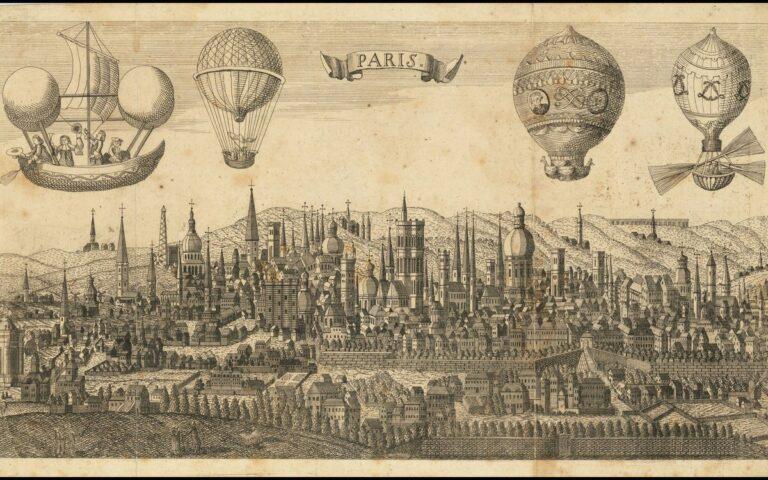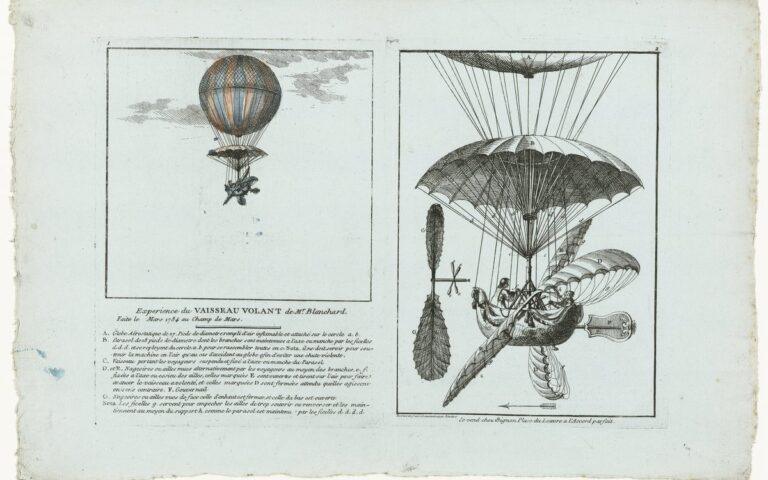
Any hot air balloon history timeline has to start in the same place we do at Wicked Balloons: with a sunrise, a wicker basket, and the quiet astonishment of leaving the ground. But the sport we practice every morning over Worcester didn’t arrive overnight. It took inventors, gamblers, and a few genuinely reckless souls more than two centuries to turn “floating in a bag of hot air” into one of the safest forms of flight there is. Here are ten moments that mattered most along the way.
1. The Montgolfier Brothers’ First Public Flight (1783)
Joseph-Michel and Jacques-Étienne Montgolfier, paper makers by trade, noticed that smoke and heated air made fabric bags rise. On June 4, 1783, they launched an unmanned linen-and-paper balloon over the town square in Annonay, France. It climbed roughly a mile into the sky before landing in a field, and word of the “aerostatic machine” spread across Europe within weeks.
The Animal Aeronauts
Before anyone trusted a human to ride along, the Montgolfiers wanted proof that the upper air wouldn’t kill a passenger. So on September 19, 1783, at the Palace of Versailles, they sent up a balloon carrying a sheep, a duck, and a rooster, with King Louis XVI and Marie Antoinette watching. All three animals landed safely a few miles away, and the path was clear for a person to go next.
2. The First Manned Free Flight (November 21, 1783)
Just two months later, Jean-François Pilâtre de Rozier and the Marquis d’Arlandes climbed into a Montgolfier balloon and lifted off from the Bois de Boulogne in Paris. They drifted across the city for about 25 minutes, tending a small fire to keep the air inside hot, and touched down safely. It was the first time in recorded history that a human being flew freely through the air, untethered from the ground.
3. Jacques Charles and the Hydrogen Balloon (December 1783)
Just ten days after the Montgolfier flight, physicist Jacques Charles launched a very different kind of balloon: one filled with hydrogen gas instead of hot air. Hydrogen balloons could stay aloft far longer without a constant flame, and Charles’s design, complete with a valve, a basket, and sandbags for ballast, set the template that gas balloons would follow for the next 150 years. Any thorough hot air balloon history timeline has to credit Charles alongside the Montgolfiers, since between them they invented the two basic approaches to lighter-than-air flight still used today.
4. Crossing the English Channel (1785)
Jean-Pierre Blanchard, a French inventor, and John Jeffries, an American physician, set their sights on a genuinely dangerous goal: flying a hydrogen balloon across the English Channel. On January 7, 1785, they lifted off from Dover and, after dumping nearly everything aboard, including most of their clothing, to stay airborne, landed safely in the Felmoise Forest near Calais. It remains one of the earliest examples of ballooning being used to accomplish something previously thought impossible, rather than just to entertain a crowd.
- Blanchard went on to make the first balloon flight in North America, in Philadelphia in 1793.
- The same Pilâtre de Rozier who made the first manned flight died in 1785 attempting his own Channel crossing, becoming ballooning’s first fatality.
- Early flights like these proved balloons could be steered, at least loosely, by wind and altitude rather than pure luck.
5. The Golden Age of Gas Balloon Exploration
Through the 1800s, gas balloons became the tool of choice for scientists and adventurers who wanted to go higher, farther, or longer than anyone before them. Balloonists carried barometers and thermometers into the upper atmosphere to study weather, and cities across Europe and America turned ballooning into public spectacle at fairs and expositions. This era cemented ballooning in the popular imagination well before airplanes existed, and it’s part of why the craft still carries a sense of old-world wonder today.
6. Ed Yost and the Modern Hot Air Balloon (Late 1950s-1960s)
Hot air ballooning nearly disappeared after gas balloons took over, until an American engineer named Ed Yost revived it. Working with a small team in the late 1950s, Yost developed a propane burner system and a lightweight nylon envelope, essentially the modern hot air balloon design still flown today. His first successful flight in this new style, in 1960 near Bruning, Nebraska, kicked off the recreational ballooning industry, and every sunrise flight we run traces its equipment lineage straight back to his workshop.
7. Double Eagle II Crosses the Atlantic (1978)
For nearly two centuries, balloonists had tried and failed to cross the Atlantic Ocean, with several attempts ending in tragedy. That changed in August 1978, when Ben Abruzzo, Maxie Anderson, and Larry Newman flew the helium balloon Double Eagle II from Presque Isle, Maine, to a landing in a barley field outside Paris. Their successful crossing made headlines worldwide and proved that long-duration gas ballooning still had milestones left to reach, more than 150 years after Blanchard’s Channel flight.
8. The First Nonstop Flight Around the World (1999)
On March 1, 1999, Bertrand Piccard and Brian Jones lifted off from the Swiss Alps in the Breitling Orbiter 3, a mixed hot air and helium balloon, and set out to do what no one had ever managed: circle the globe without landing. Nearly 20 days later, they touched down in the Egyptian desert, having completed the first nonstop balloon flight around the world. It stands as one of the defining achievements in the entire hot air balloon history timeline, closing a chapter that had been open since the earliest transatlantic attempts a century before.
9. Steve Fossett’s Solo Circumnavigation (2002)
Piccard and Jones had a crew of two and a support team tracking their every move. American adventurer Steve Fossett wanted to do it alone. After several failed attempts, he finally succeeded in June and July of 2002, flying the Spirit of Freedom solo around the world in roughly two weeks. It was a milestone in endurance and self-reliance that pushed ballooning’s reputation from “quaint hobby” to “serious feat of human achievement” in the eyes of the wider public.
10. Ballooning Today, Rooted in All of It
Modern hot air ballooning, the kind you’ll experience with us over the fields and hilltops of Central Massachusetts, is a direct descendant of every milestone on this list. The envelope shape, the propane burner, the basket, even the calm early-morning launch window that pilots still favor because the air is smoothest then, all of it comes from more than two centuries of trial, error, and genuine bravery. Every flight is a small callback to that morning in 1783 when a sheep, a duck, and a rooster proved it could be done. If you’d like to see how it all comes together firsthand, our team’s story and approach to flying covers how we carry that history forward today.
Frequently Asked Questions
What was the very first hot air balloon flight?
The first untethered, unmanned demonstration was launched by the Montgolfier brothers on June 4, 1783, in Annonay, France. The first manned free flight followed that November, carrying Pilâtre de Rozier and the Marquis d’Arlandes over Paris.
Who invented the modern hot air balloon used today?
American engineer Ed Yost is generally credited with developing the propane burner and nylon envelope design that defines modern recreational hot air balloons, achieving his breakthrough flight in 1960.
What’s the difference between a hot air balloon and a gas balloon?
A hot air balloon rises because burners heat the air inside the envelope, and pilots control altitude by adjusting that heat. A gas balloon, like the hydrogen and helium balloons used for early long-distance records, relies on a lighter-than-air gas sealed inside the envelope instead of heated air.
How long has ballooning been a recreational activity in the United States?
Balloon flight arrived in North America in 1793 with Jean-Pierre Blanchard’s flight in Philadelphia, but ballooning as a widespread recreational activity really took off after Ed Yost’s modern design made hot air balloons practical and affordable in the 1960s.
From a sheep-and-duck test flight at Versailles to a nonstop trip around the entire globe, ballooning’s history is really a story of people refusing to accept “that’s impossible.” We’re proud to keep a small part of that tradition alive every time we launch, and we’d love to have you along for the ride. Check our available sunrise flight times if you’re ready to add your own chapter.