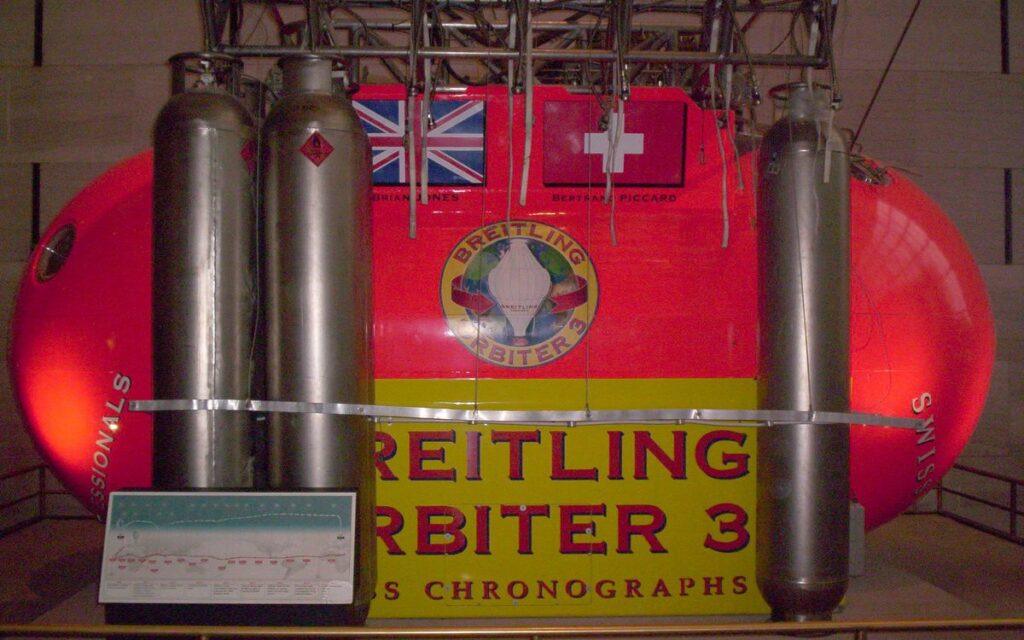
On March 21, 1999, a silver capsule slipped down out of the African sky and touched the Egyptian desert, closing the book on the first balloon around the world without stopping. The flight of the Breitling Orbiter 3 had lasted nearly twenty days and covered close to 29,000 miles, and it settled a question balloonists had been chasing for decades: could a gas balloon truly circle the globe on a single tank of ballast and a lot of nerve?
Here at Wicked Balloons, we spend our mornings drifting a few thousand feet over the fields of Central Massachusetts, so a nineteen-day, round-the-planet voyage is almost impossible for us to picture. But every sunrise flight we fly still traces back to the same basic idea that carried that crew across three continents and two oceans: trust the wind, read it well, and let it do the work.
The Race for the First Balloon Around the World
By the 1990s, ballooning had already produced plenty of firsts: the first Atlantic crossing, the first Pacific crossing, the first solo circumnavigation attempts. What remained was the biggest prize in the sport, and it drew serious money and serious competition. Teams from several countries spent years and small fortunes trying to be first, using specially built helium-and-hot-air “Rozière” balloons capable of carrying a pressurized capsule high into the jet stream, where the fastest, most reliable winds circle the earth.
Several attempts in the late 1990s ended in the ocean, in the mountains, or in disputes over flight paths and airspace permissions. Each failure taught the next team something new about weather routing, fuel management, and the sheer endurance required to live in a capsule the size of a small camper for weeks at a time.
Piccard, Jones, and the Breitling Orbiter 3
The team that finally succeeded was Swiss psychiatrist and balloonist Bertrand Piccard, flying with British balloonist Brian Jones. They launched the Breitling Orbiter 3 from Château-d’Oex, Switzerland, on March 1, 1999. Piccard came from a family with deep exploration roots; his father and grandfather had each set records of their own, in the deep ocean and the stratosphere, and Bertrand had already made two earlier, unsuccessful attempts at circling the globe by balloon before this one succeeded.
Their Rozière balloon combined a helium cell for lift with a hot-air chamber that let the crew fine-tune altitude by day and night, a design that made long-duration flight practical in a way pure gas balloons never quite managed. Piccard and Jones rode the jet stream eastward across North Africa, the Arabian Peninsula, India, and the vast expanse of the Pacific and beyond, adjusting altitude constantly to catch the fastest and most favorable bands of wind.
What Made This Nonstop Flight Around the World So Difficult
Anyone who has watched a sunrise balloon ride knows how much a flight depends on the wind doing something predictable. Now imagine needing that cooperation for nearly three weeks straight, across a dozen countries and every kind of weather the planet can produce.
- Fuel and ballast limits: everything the crew needed, food, propane, and life support, had to fit in the capsule from day one, with no chance to resupply mid-flight.
- Diplomatic clearance: a balloon at the mercy of the jet stream cannot simply avoid restricted airspace, so the route had to be negotiated with multiple governments in advance and adjusted in flight.
- Extreme cold and cramped quarters: the crew lived and slept in a small pressurized capsule for roughly nineteen days, managing altitude changes around the clock.
- Weather routing: a dedicated ground team tracked global wind patterns continuously, guiding the balloon toward the fastest, safest currents at each stage of the journey.
The flight finally ended over Egypt, where Piccard and Jones landed in the desert after having circled the entire globe without landing, becoming the first balloon around the world to do it nonstop. It remains one of the defining achievements in the history of flight, mentioned in the same breath as the first nonstop airplane circumnavigation decades earlier.
Why the First Balloon Around the World Still Matters to Pilots Today
Every balloon pilot, whether flying a Rozière capsule over the Sahara or a passenger basket over the Blackstone Valley, lives by the same relationship with the wind. You cannot outrun it, argue with it, or overpower it with a bigger engine. You read it, you respect it, and you let it carry you somewhere worth seeing.
That’s part of what draws so many of us to this sport in the first place, and it’s something we try to share with every guest who climbs into a basket with our team at Wicked Balloons. The scale is different, a sunrise flight over New England is measured in an hour, not nineteen days, but the fundamentals of watching the sky and trusting the currents are exactly the same ones that carried the Breitling Orbiter 3 around the planet.
Frequently Asked Questions
Who completed the first nonstop balloon flight around the world?
Bertrand Piccard of Switzerland and Brian Jones of the United Kingdom completed the flight together aboard the Breitling Orbiter 3, launching March 1, 1999, and landing in Egypt on March 21, 1999.
How long did the flight take?
The journey lasted just under twenty days, making it one of the longest continuous flights, by balloon or otherwise, ever completed at that time.
What kind of balloon did they use?
They flew a Rozière balloon, a hybrid design that pairs a sealed helium gas cell with a hot-air chamber, letting the crew adjust altitude without burning through ballast the way a pure gas balloon would.
Has anyone else flown around the world by balloon since then?
Yes. Other balloonists have since completed solo and crewed circumnavigations using different routes and balloon designs, but the Breitling Orbiter 3 remains recognized as the first to do it nonstop.
The next time you watch a balloon lift off at sunrise, take a moment to think about how far this sport has traveled, literally. From a quiet field to a genuine trip around the globe, ballooning has always been about trusting the wind to take you somewhere remarkable. If you would like to feel a small piece of that yourself, we would love to have you along on one of our sunrise flights.