Stand under an inflated hot air balloon and it looks weightless, a giant soap bubble tugging gently at its tether. So how much does a hot air balloon weigh, really? The honest answer is: a lot more than it looks, and a lot less than you’d guess once it’s airborne. A typical passenger balloon system, envelope, basket, burners, fuel, and all, can weigh somewhere in the neighborhood of a half-ton to a full ton on the ground. In the air, that same balloon is perfectly buoyant, held aloft by nothing but heated air and clever engineering.
At Wicked Balloons, we get this question all the time from guests booking a sunrise flight over Worcester County. It’s a great one, because the answer touches on everything that makes ballooning work: fabric, physics, and fire.
How Much Does a Hot Air Balloon Weigh on the Ground?
Before we talk about flight, let’s talk about hauling the thing to the launch field. A complete hot air balloon system is made up of a few major components, and each one adds its own share of pounds:
- The envelope (the fabric balloon itself) — typically a few hundred pounds, depending on size and how many panels of ripstop nylon or polyester it takes to build it
- The basket (traditionally wicker, sometimes reinforced with steel cabling) — another couple hundred pounds
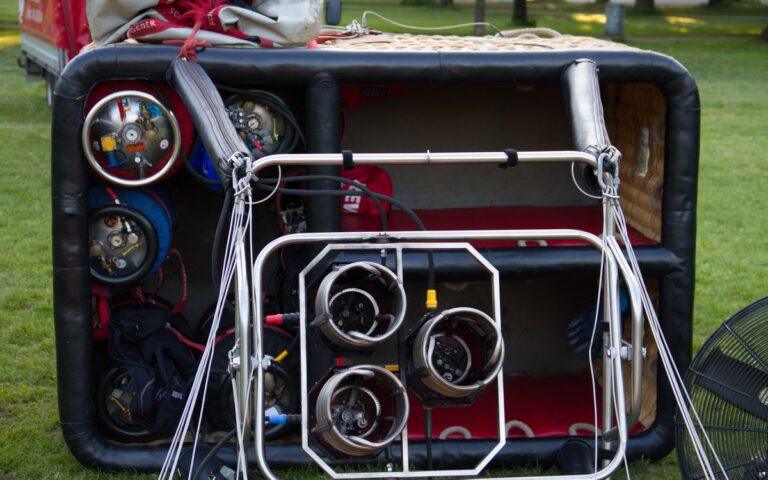
- The burner assembly and fuel tanks — steel tanks filled with liquid propane add real weight, especially on a balloon carrying enough fuel for a full flight
- Passengers and gear — the variable that changes every single flight
Add it all up, and a mid-size passenger balloon designed to carry a handful of people commonly comes in somewhere between 1,000 and 2,000 pounds fully loaded with fuel and crew. Larger balloons built for bigger passenger groups weigh more; smaller sport balloons flown solo weigh less. That’s why the question of how much a hot air balloon weighs doesn’t have one single number attached to it. It depends entirely on the balloon’s size, or what pilots call its envelope volume, measured in cubic feet.
Why Envelope Size Drives Everything
A bigger envelope needs more fabric to hold more air, which needs a bigger, heavier basket to hold more passengers, which needs more burner power and more fuel to lift it all. It’s a chain reaction. A balloon built to carry two people is a fundamentally different (and much lighter) machine than one built to carry a dozen.
How Does a Hot Air Balloon Actually Get Off the Ground?
This is where the “how much does a hot air balloon weigh” question gets interesting, because weight alone doesn’t determine whether something flies. Buoyancy does.
Hot air is less dense than cool air. When the burners heat the air trapped inside the envelope, that heated air becomes lighter than the air surrounding the balloon outside. The result is a lifting force, the same basic principle that lets a hot air current rise off a summer sidewalk, just harnessed on a much larger scale. Once the air inside the envelope is warm enough, the buoyant force generated is greater than the combined weight of the fabric, the basket, the fuel, the burner, and everyone on board, and the whole system lifts gently off the ground.
This is also why pilots talk about a balloon’s total weight, not just the envelope’s weight, when they’re planning a flight. The passengers matter. The fuel load matters. Even the morning temperature matters, because cooler ambient air is denser and gives the balloon a bit more lifting margin. Every launch is a small calculation balancing how much needs to go up against how much heat and buoyancy is available to lift it.
What Makes Balloon Fabric So Light, Yet So Strong?
The envelope is the biggest visual part of a hot air balloon, but it’s surprisingly light for its size given how much surface area it covers. Modern envelopes are cut from dozens of long fabric panels, called gores, sewn together and reinforced with load tapes that carry the weight down to the basket through a network of suspension cables.
The fabric itself is thin, but it’s woven and coated to handle serious heat near the burner’s mouth and serious stress everywhere else. That combination, light material engineered to carry heavy loads, is a big part of why hot air ballooning has remained one of the most efficient and low-impact forms of flight for well over two centuries.
Does Balloon Size Affect the Ride Experience?
Guests sometimes worry that a heavier, larger balloon will feel sluggish, or that a smaller one will feel unstable. In practice, neither is true. A well-built and well-flown balloon, regardless of size, offers the same quiet, drifting experience once it’s aloft. Larger balloons simply carry more people and require more lift to get there. Our pilots size the balloon to the group and the conditions of the day, which is part of why every one of our sunrise balloon rides starts with careful weather and weight planning long before anyone climbs into the basket.
Frequently Asked Questions
How much does a hot air balloon envelope alone weigh?
The fabric envelope, by itself, generally makes up a few hundred pounds of a balloon’s total weight, depending on its size and the materials used. It’s the lightest major component relative to how much volume it holds.
How much weight can a hot air balloon lift?
It varies widely by balloon size. Larger commercial passenger balloons are built to lift several people plus a pilot, fuel, and equipment, while smaller sport balloons are designed for just one or two occupants. Lift capacity is always matched to the specific balloon’s envelope volume and burner output.
Does a heavier hot air balloon need more fuel?
Yes. More total weight, whether from a larger basket, more passengers, or more fuel on board, requires more heat to maintain buoyant lift, which means burning more propane throughout the flight.
Why do hot air balloons feel weightless in flight even though they’re heavy on the ground?
Once the air inside the envelope is heated enough, the balloon’s buoyancy exceeds its total weight, so it floats rather than strains against gravity. There’s no engine fighting against weight the way an airplane’s does; the balloon simply rises and drifts with the lift it has generated.
So the next time you watch a hot air balloon rise over a New England field at sunrise, you’ll know there’s real engineering hiding behind that graceful float, hundreds of pounds of fabric, basket, and fuel, all balanced perfectly against the invisible lift of heated air. If you’d like to feel that balance for yourself, our reservations page makes it easy to book a morning flight and see it firsthand.